 Franz
A1Reading4 min read
An easy French story for beginners: the first class
Six sentences, one twist, and the exact routine to read it: once in the morning, once in the evening. A complete A1 reading lesson, from the story to the words you keep.
SLDBBy Stan Lee MBINI and Darcya Hamilton BOULINGUI BOULINGUI
C'est ma petite-fille !
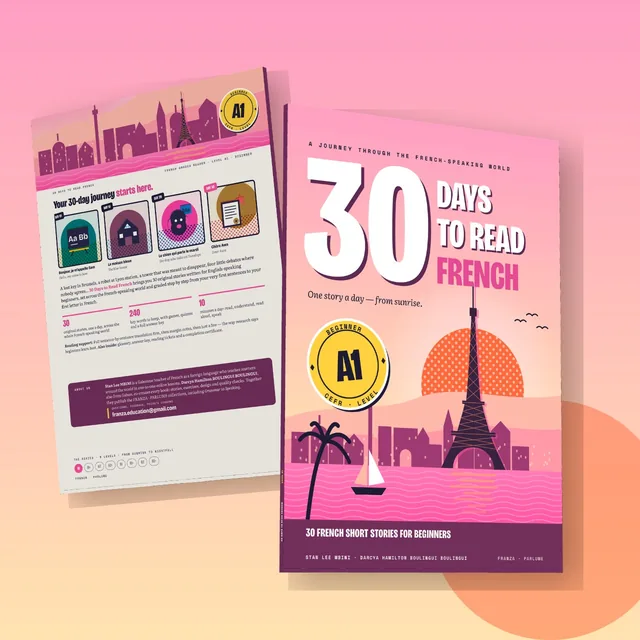
She's my granddaughter!This is the kind of story we use in our lessons, and the first story of 30 Days to Read French, A1. It is short on purpose: at A1, a story you can read twice a day is worth more than a long text you abandon. Read it once in French only, and see how far you can follow.
Bonjour ! Je m'appelle Sam.Hello! My name is Sam.
J'ai trente ans. J'habite à Dakar.I'm thirty. I live in Dakar.
Aujourd'hui, j'ai mon premier cours de français.Today I have my first French class.
À côté de moi, il y a Awa. Elle a soixante-dix ans.Next to me is Awa. She's seventy.
Awa sourit : « La professeure…Awa smiles: “The teacher…
… c'est ma petite-fille ! »…is my granddaughter!”
Did you get the twist?
Your turn
La professeure, c'est…
La petite-fille is the granddaughter. La fille is the daughter. One word, petite, changes the whole family.
How to read it: the FRANZA routine
Reading once is not enough for the words to stay. This is the routine we give our students for every story in 30 Days to Read French, and the reason it works is simple: the same text, twice in the same day, moves words from your eyes to your memory.
- Morning, 10 minutesRead the story once without stopping. Then read it again and underline every word you do not know. Write its meaning next to it, in English, and write le or la in front of every noun.
- Evening, 5 minutesBefore you open the page, try to remember the morning's words. Write the ones you recall. Then read the same story again, out loud, a little faster than this morning.
- Every day for 30 daysOne new story a day, read at least twice, three times if you can. When a grammar point surprises you, open its lesson in Grammar to Speaking.
Three things to notice
Now say it
Reading builds the words; speaking puts them to work. Tell the story out loud in your own words, then tell your own version: who you are, how old you are, where you live, and who sits next to you in class.
Je m'appelle… J'ai… ans. J'habite à…
My name is… I'm… I live in…À côté de moi, il y a…
Next to me, there is…C'est mon ami / mon amie.
He's / she's my friend.Words to remember
le, un: masculinela, une: feminineTap ☆ to save a word to My words
- le coursclass, lesson · masculineJ'ai un cours de français.
- la professeureteacher (woman) · feminineLa professeure est jeune.
- la petite-fillegranddaughter · feminineC'est ma petite-fille.
- la filledaughter, girl · feminineElle a une fille.
- l'ami / l'amiefriendC'est mon amie Awa.
- aujourd'huitodayAujourd'hui, j'ai cours.
Expressions to remember
- je m'appelle…my name is…Je m'appelle Sam.
- j'habite à…I live in…J'habite à Dakar.
- à côté denext toÀ côté de moi, il y a Awa.
- il y athere is / there areIl y a dix étudiants.
- c'est…it's… / he's… / she's…C'est ma petite-fille.